CASE 02 / DEVELOPER TOOL
智能体脉搏 · 2026 · M4 VALIDATION
AGENTPULSE
A privacy-first observability layer for coding agents working across devices.
统一观察 Claude Code 与 Codex 会话状态,同时默认不上传 Prompt、代码和完整路径。
Deterministic multi-device validation workload backed by PostgreSQL 18.4.
Signed registration, owner isolation, replay and query boundaries were exercised together.
Observed through a local Codex CLI 0.144.2 read-only collection run.
Falls back to a calmer 10-second cadence when no session is active.
01 / Product evidence
See the system at work.
Captured from the working product and its repository-backed preview states.
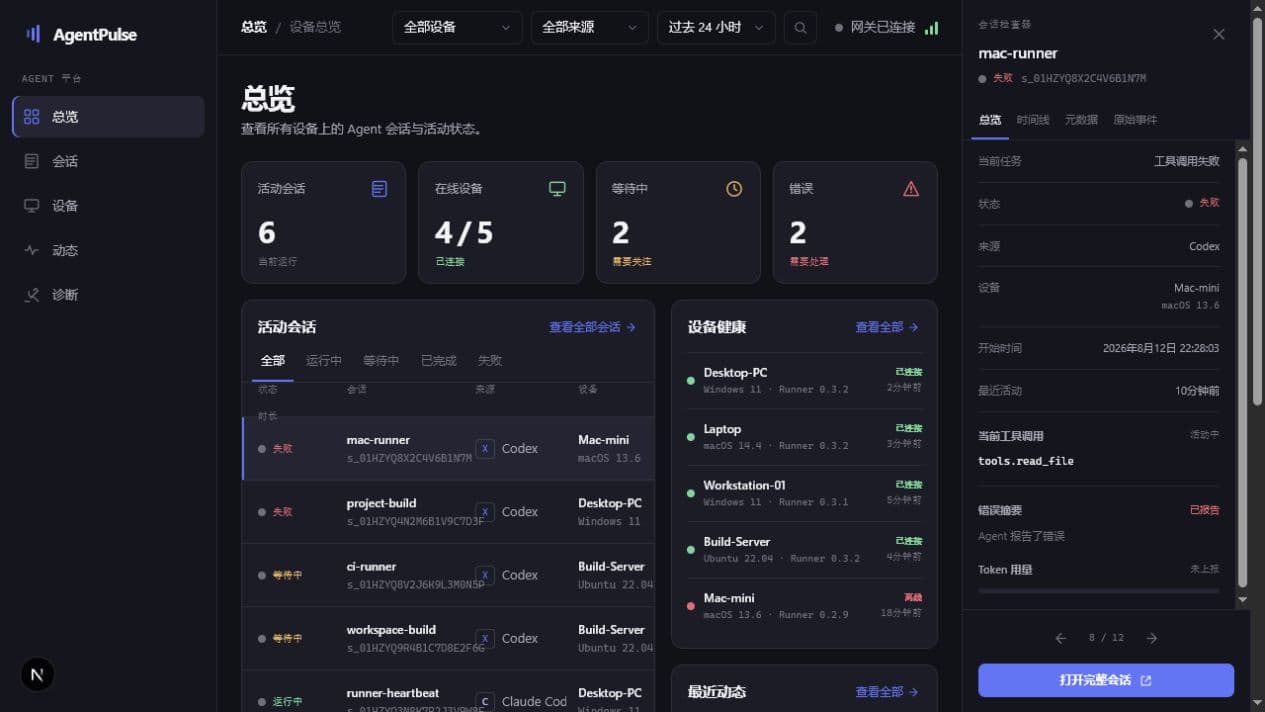
The overview compresses cross-device activity into the few states that may need a human decision.
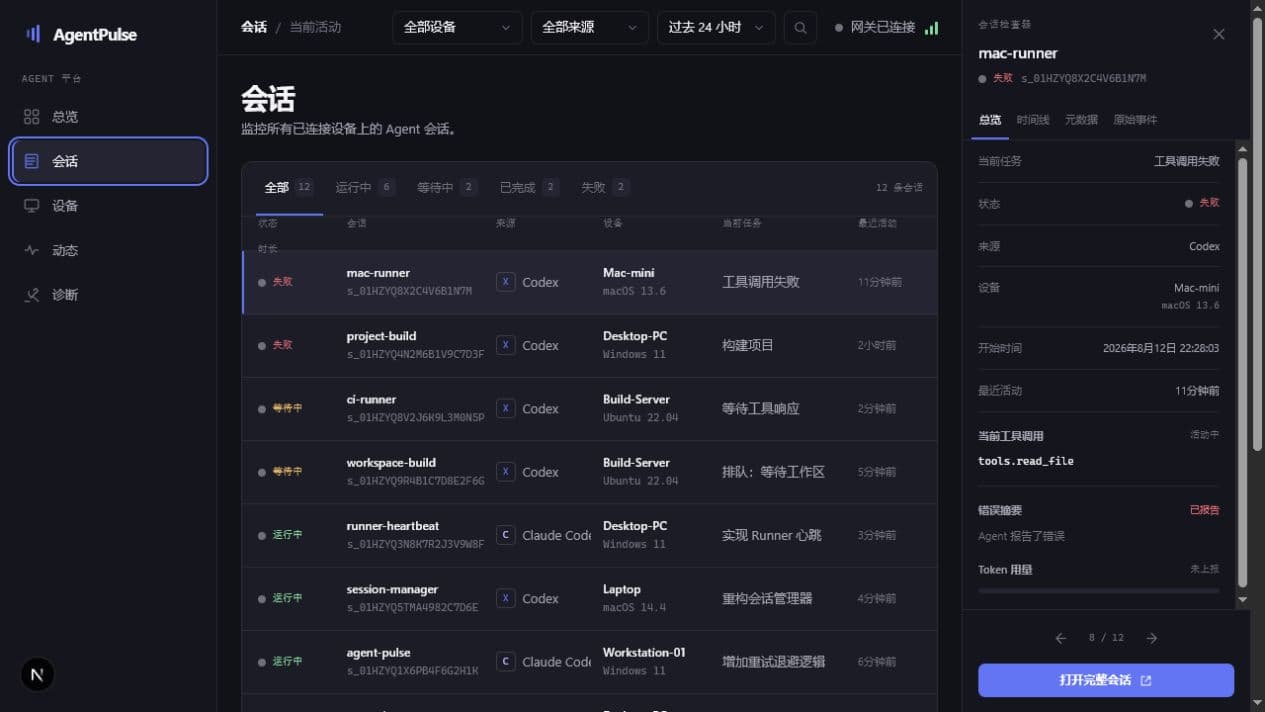
A shared state model makes Codex and Claude Code sessions comparable without mirroring their transcripts.
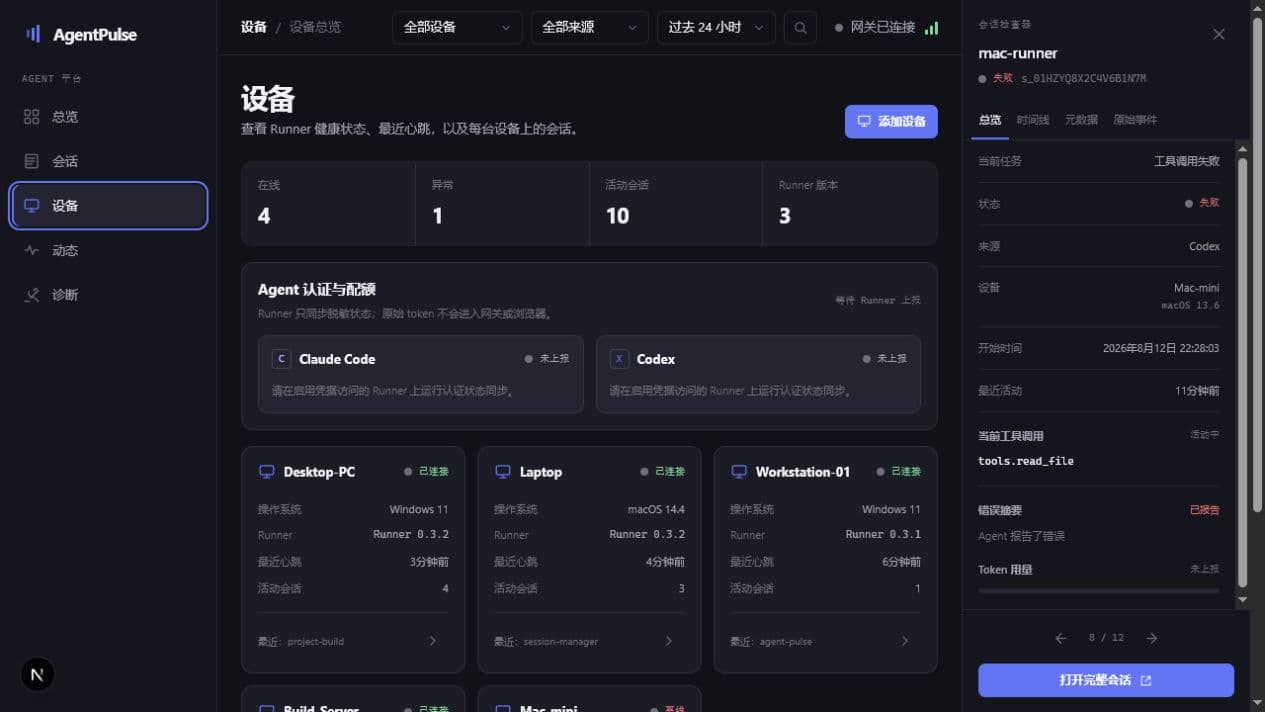
Runner health, versions and last contact are visible independently from the work being observed.
02 / Problem and response
Role
Product design · protocol · Rust runner · gateway · Web/PWA · native Android
Parallel coding agents create an attention problem, but conventional telemetry would expose exactly the private material the tool is meant to protect.
Collect a strict metadata allow-list locally, sign ordered batches on device, survive disconnection in a SQLite outbox and render confidence-aware state remotely.
03 / System trace
How the system moves.
- 01
Observe
Claude and Codex adapters read official interfaces and local hooks without starting or controlling sessions.
- 02
Normalize
Raw states become a shared presence/activity model with source and confidence attached.
- 03
Queue
A device-local SQLite outbox preserves ordered events through restarts and network failure.
- 04
Verify
The gateway checks schema, device identity, Ed25519 signatures and monotonic sequence before storage.
- 05
Focus
Web and Android surfaces emphasize sessions that need a human decision instead of mirroring transcripts.
04 / Engineering decisions
The important work happened at the boundaries.
Model presence and activity separately
A persisted historical session is not the same thing as an active task. Keeping both axes avoids fabricated certainty.
Use an allow-list protocol
Unknown fields are rejected instead of silently becoming a new route for code, prompts or credentials.
Keep collection and sync failure independent
Network backoff cannot block local observation; new events continue accumulating safely in the outbox.
05 / Proof, not promise
These statements come from the project's local repository, manifests and validation notes—not invented portfolio metrics.
Fixtures containing prompts, titles, commands, messages and path markers are asserted absent after adapter → outbox → signed batch.
VERIFIED TRACE12 devices and 3,000 sessions validated isolation, replay idempotency and bounded query fields.
VERIFIED TRACECodex CLI 0.144.2 produced 35 allow-listed session observations without content fields.
VERIFIED TRACEEvents remain on disk after an unreachable gateway and clear only after a valid acknowledgement.
VERIFIED TRACE06 / Build record
Adapters, normalized state and the local SQLite outbox.
Signed device sync, PostgreSQL gateway, Web/PWA and native Android clients.
Security, offline recovery, authentication and multi-device validation baseline.